

The Gut Microbiome Isn’t a Trend. But It’s Also Not Magic.
What we actually know about your gut microbes, what they do, and why your next probiotic probably isn't the answer to everything.
There are few areas of wellness that have exploded quite like gut health.
You can now buy a probiotic for almost anything.
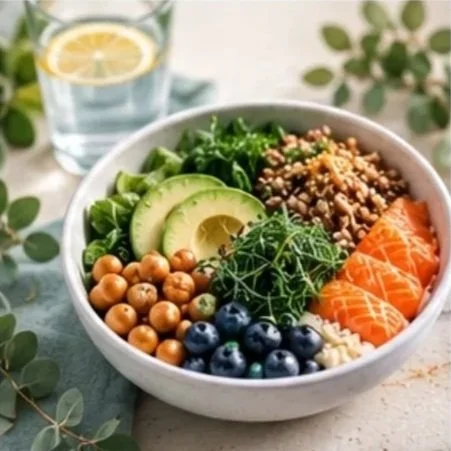
A well-balanced, whole-foods diet is key to lasting health.
Bloating.
Hormones.
Immunity.
Mood.
Weight loss.
Skin.
Detoxification.
You can order a microbiome test from your living room, receive a colorful report telling you which bacteria are "good" or "bad," and buy a supplement designed to "rebalance" your gut.
It sounds wonderfully scientific.
And sometimes, it is.
But sometimes, it's marketing wearing a lab coat.
The gut microbiome is real. It is incredibly important. And researchers are discovering more about it every year.
But we're still learning how to translate that science into individualized clinical care.
The microbiome is fascinating. It just isn't magic.
First, let's clear up the terminology.
You will often hear microbiome and microbiota used interchangeably, but technically they aren't quite the same thing.
Your gut microbiota refers to the microorganisms living in your gastrointestinal tract—bacteria, but also fungi, viruses, archaea, and other organisms.
The microbiome is a broader term that can refer to those organisms and their genetic material and functional capabilities.
And there are a lot of them.
Your gastrointestinal tract is home to a remarkably complex microbial ecosystem that interacts with the food you eat, your intestinal lining, your immune system, your nervous system, and your metabolism.
Researchers increasingly view the gut microbiome not as a passive collection of bacteria but as an active biological community involved in nutrient metabolism, immune signaling, barrier function, and communication between the gut and other organs.
That is a very big deal.
But it also brings us to our first important distinction:
Having bacteria in your gut isn't the goal.
You already have them.
The question is what that ecosystem is doing.
Your gut microbes are busy.
Think of your microbiota as an ecosystem rather than a list of organisms.
Different microbes consume different substrates. They produce different metabolites. They interact with one another. They interact with the cells lining your intestine. They interact with your immune system.
And what you eat helps determine what resources are available to that ecosystem.
One of the most studied examples is dietary fiber.
Humans can't fully digest many forms of dietary fiber in the small intestine. That means some of it reaches the colon, where gut microbes can ferment it.
One result is the production of short-chain fatty acids, including acetate, propionate, and butyrate.
These compounds aren't just bacterial waste.
They can interact with intestinal cells, immune pathways, and metabolic signaling. Butyrate, in particular, serves as an important energy source for colon cells and has been studied for its role in intestinal barrier function and immune regulation.
This is one reason fiber is so much more interesting than simply:
"Eat fiber because it keeps you regular."
Fiber is feeding an ecosystem.
And different types of fiber can support different microbial functions.
Your gut doesn't eat "fiber."
This is one of my favorite nuances in microbiome science.
We often talk about fiber as though it's one thing.
It isn't.
There are many different types of dietary fiber with different structures, properties, and fermentability.
Some are readily fermented by particular microbes. Others move more slowly through the digestive tract. Some influence stool formation and transit. Some can support production of short-chain fatty acids.
And different people can respond differently to the same fiber.
A 2024 review in Nature Reviews Microbiology highlighted just how complex the relationship is between dietary fiber, the microbiome, and health. Fiber can alter microbial ecology and metabolism, but the specific microbial response varies between individuals, and the relationship between fiber intake and "microbial diversity" isn't as simple as saying more diversity automatically equals better health.
That's important.
Because you've probably heard:
"You need to increase your microbiome diversity."
Maybe.
But diversity isn't a report card.
A more diverse microbiome isn't automatically a healthier microbiome, and simply counting how many microbial species are present doesn't tell us everything about what those microbes are doing.
Function matters.
Context matters.
And the person matters.
So what should you feed your microbiome?
This is where the science becomes refreshingly unsexy.
Before we start buying $60 powders, we should probably look at what's already on the plate.
Whole grains.
Beans and lentils.
Vegetables.
Fruit.
Nuts and seeds.
A variety of plant foods.
Fermented foods when tolerated.
These foods provide a wide range of fibers, resistant starches, polyphenols, and other compounds that interact with the microbial ecosystem.
And dietary patterns matter.
Research increasingly shows that the relationship between diet and the microbiome is bidirectional: what you eat influences the microbial community, while microbial metabolism can influence how nutrients and dietary compounds affect the host.
This is one reason I prefer talking about patterns instead of "superfoods."
Your gut doesn't need one magical ingredient.
It needs an environment that supports a functioning ecosystem.
What about fermented foods?
Here's another place where the internet has gotten a little carried away.
Fermented foods can be a wonderful addition to a varied diet.
But fermented food is not automatically synonymous with probiotic.
That's an important distinction.
A probiotic, by scientific definition, is a live microorganism that, when administered in adequate amounts, confers a health benefit on the host.
That means the specific microorganism, dose, and demonstrated health benefit matter.
A fermented food may contain live microorganisms.
But unless a specific microorganism has been shown to provide a health benefit under appropriate conditions, calling it a "probiotic" isn't scientifically accurate.
And fermentation itself can change the nutritional characteristics of food in interesting ways.
A 2026 review examining fermented-food microbiomes describes potential effects involving microbial metabolites, nutrient bioavailability, and interactions with the oral and gut microbiota—but also emphasizes that human evidence remains heterogeneous and that the mechanisms behind many proposed benefits are still being worked out.
So yes:
Eat the kimchi.
Enjoy the sauerkraut.
Have the fermented foods you actually like.
But you don't need to turn your refrigerator into a fermentation laboratory in pursuit of perfect gut health.
And about probiotics...
This is where I really want you to slow down before buying the biggest bottle with the most strains.
More strains doesn't automatically mean better.
More colony-forming units doesn't automatically mean better.
And "50 billion CFU" doesn't mean very much if those organisms haven't been studied for the outcome you're actually trying to improve.
Different probiotic strains can have different effects.
A strain that has evidence for one clinical outcome doesn't automatically have evidence for another.
The International Scientific Association for Probiotics and Prebiotics emphasizes that probiotic benefits are strain-specific and that products should be evaluated according to the evidence supporting the particular strain, dose, and health outcome.
That's a very different philosophy from:
"Take a probiotic because everyone should."
Some probiotics have evidence for specific gastrointestinal outcomes.
Others have little meaningful clinical evidence.
And some products marketed as probiotics don't meet the scientific definition at all.
Here's an uncomfortable example.
You may have heard that probiotics "restore your gut" after antibiotics.
It's an appealing story.
Antibiotics can disrupt the gut microbial community.
Therefore:
Antibiotics → bad bacteria → probiotics → restore good bacteria.
Except human biology rarely behaves that neatly.
An expert panel reviewing the evidence found that although certain probiotics can reduce some clinical harms associated with antibiotic use, current evidence does not support the conclusion that probiotics studied so far reliably restore the gut microbiota to its pre-antibiotic state.
That's a really important distinction.
A probiotic may have a clinical benefit without "rebuilding your microbiome."
And changing your microbiome doesn't automatically mean you've improved your health.
The outcome matters more than the marketing story.
Which brings us to microbiome testing.
This is probably the most important conversation in this entire Field Note.
Because now you can order a stool microbiome test that tells you exactly which organisms were found in your sample.
It looks incredibly personalized.
And that's where we have to be careful.
The science of measuring the microbiome has advanced dramatically.
Our ability to sequence microbial DNA is extraordinary.
But being able to measure something does not automatically mean we know what to do with the result.
An international multidisciplinary expert panel published a consensus statement on microbiome testing in clinical practice, noting that evidence supporting the clinical usefulness of these tests remains limited and that there is currently no universal consensus around how commercial direct-to-consumer microbiome testing should be interpreted or used clinically.
That's not saying:
"Microbiome testing is useless."
It's saying:
"We need to know what a result actually means before we build medical decisions around it."
Those are very different statements.
Your microbiome isn't a personality test.
One of the biggest problems with commercial microbiome reports is the temptation to label organisms as:
good
or
bad
as though your gut were a high school cafeteria.
But microbial ecosystems are more complicated than that.
A microorganism that is associated with health in one context may not tell us much about an individual person's health in another.
And the presence or absence of a particular organism doesn't necessarily tell us whether that organism is active, what it's doing, how it interacts with the rest of the community, or what intervention will meaningfully change your outcome.
We are still figuring this out.
That doesn't make the science less exciting.
It makes it more important that we respect what the science actually says.
So what does gut health actually look like?
It probably looks much less glamorous than Instagram would have us believe.
It looks like eating a varied diet.
It looks like getting enough fiber.
It looks like regular movement.
It looks like adequate sleep.
It looks like managing chronic stress—not because stress "kills your good bacteria," but because the gut and nervous system are deeply interconnected.
It looks like paying attention to symptoms.
It looks like investigating persistent digestive problems rather than simply throwing supplements at them.
It looks like using medications appropriately when they're needed.
It looks like recognizing that sometimes bloating is dietary.
Sometimes it's constipation.
Sometimes it's a food intolerance.
Sometimes it's IBS.
Sometimes it's celiac disease.
Sometimes it's something else entirely.
"Gut imbalance" is not a diagnosis.
And "heal your gut" isn't a treatment plan.
We need to know what we're actually treating.
The gut-brain connection is real. The hype is still ahead of the evidence.
This is another area where there's both fascinating science and a lot of overstatement.
Your gut and brain communicate through multiple pathways, including neural, immune, endocrine, and microbial signals.
Short-chain fatty acids and other microbial metabolites are being investigated as part of this communication network.
There is exciting research exploring relationships between the microbiome and mood, cognition, stress responses, and neurological disease.
But here's the important qualifier:
Exciting doesn't mean proven.
Human evidence linking specific microbiome interventions to improvements in mental health is still developing, and many mechanistic findings come from animal or laboratory studies.
So if someone tells you that a specific probiotic will "fix your anxiety through the gut-brain axis," skepticism is warranted.
The biology is real.
The certainty of the claim may not be.
What I actually want you to take away
The gut microbiome is not a fad.
It's not a wellness invention.
It's a legitimate and rapidly evolving area of biomedical research.
We have compelling evidence that the microbes living in and around our gastrointestinal tract interact with our diet, intestinal barrier, immune system, metabolism, and other physiological systems.
But we are not at the point where we can look at a stool sample and confidently tell every person:
"Here is exactly what your microbiome needs."
We are getting closer to more personalized microbiome-informed care.
We're just not there yet.
And honestly?
That's okay.
Medicine doesn't need to pretend we know everything.
Good medicine knows where the evidence ends.
Five things I'd focus on before buying another gut supplement
01 — Eat a more diverse diet.
Not a more complicated diet.
A more diverse one.
Different plants provide different fibers and phytochemicals, which can interact with different microbial pathways.
02 — Prioritize fiber, but increase it thoughtfully.
More isn't always better if your current intake is low and your gut isn't accustomed to it.
Gradual increases, adequate fluids, and attention to your individual tolerance matter.
03 — Don't automatically reach for a probiotic.
If you're considering one, ask a better question:
"What specific problem am I trying to address, and is there evidence for this particular strain and dose?"
04 — Be cautious with commercial microbiome tests.
A colorful report can be interesting.
But a result isn't automatically a diagnosis, and a recommendation isn't automatically evidence-based.
05 — Pay attention to persistent symptoms.
Ongoing diarrhea, constipation, abdominal pain, blood in the stool, unexplained weight changes, persistent vomiting, or other concerning symptoms deserve appropriate medical evaluation—not a new supplement protocol.
Your gut doesn't need perfection.
This may be my favorite part of the entire conversation.
Because the wellness industry has a way of turning health into another performance metric.
Perfect microbiome.
Perfect digestion.
Perfect bowel movements.
Perfect diet.
Perfect supplement stack.
Perfect everything.
But your gut is an ecosystem.
Ecosystems change.
They respond to food, medications, illness, stress, environment, age, and countless other factors.
The goal isn't to create some imaginary state of microbial perfection.
It's to create the conditions that support your body's ability to function well.
Sometimes that means adding fiber.
Sometimes it means changing the overall dietary pattern.
Sometimes it means treating constipation.
Sometimes it means stopping a medication that's contributing to symptoms—but only when medically appropriate.
Sometimes it means a targeted intervention.
And sometimes it means discovering that what you thought was a "gut problem" is actually something else entirely.
That's why individualized care matters.
The Calyx Perspective
At Calyx, I don't want to sell you a fantasy about your microbiome.
I want to help you understand your whole digestive system.
Your symptoms.
Your nutrition.
Your medications.
Your lifestyle.
Your metabolic health.
Your history.
And, when appropriate, the testing that can actually help us make a better decision.
Because gut health isn't about chasing the perfect collection of bacteria.
It's about creating the conditions for your body to function, adapt, and thrive.
The microbiome is part of that story.
It just isn't the whole story.
🌿 Ready to take a deeper look at your digestive health?
Explore Digestive Restoration at Calyx Health to learn how personalized care can help uncover what's actually driving your symptoms—and create a plan built around you, not the latest gut-health trend.
Research & Resources
Sanz et al., Nature Reviews Gastroenterology & Hepatology (2025)
The gut microbiome connects nutrition and human health. An excellent overview of the complex relationship between diet, the microbiome, immunity, the nervous system, and cardiometabolic health.
Delzenne et al., Nature Reviews Microbiology (2025)
The gut microbiome and dietary fibres: implications in obesity, cardiometabolic diseases and cancer. A detailed review of how different fibers interact with the gut microbiome and why individual responses vary.
Mukhopadhya & Louis, Nature Reviews Microbiology (2025)
Gut microbiota-derived short-chain fatty acids and their role in human health and disease. A deeper look at microbial metabolites such as acetate, propionate, and butyrate and their effects on the host.
Szajewska et al., Nature Reviews Gastroenterology & Hepatology (2024)
Antibiotic-perturbed microbiota and the role of probiotics. Expert review examining whether probiotics actually restore the microbiome after antibiotics.
International Scientific Association for Probiotics and Prebiotics (ISAPP)
Evidence-based resources explaining what qualifies as a probiotic, why strains matter, and how probiotic claims should be interpreted.
International consensus statement on microbiome testing in clinical practice (2025)
An international expert consensus addressing the current evidence, limitations, and clinical use of microbiome testing.
Ross et al., Nature Reviews Microbiology (2024)
The interplay between diet and the gut microbiome: implications for health and disease. A broad review of how dietary patterns—including high-fiber, Mediterranean, plant-based, high-protein, ketogenic, and Western diets—interact with the microbiome.
This article is for educational purposes and is not a substitute for individualized medical advice, diagnosis, or treatment.
